
Author: Dr. Jibu Eapen Mathew, Senior Consultant - General Surgery & Robotic Surgery
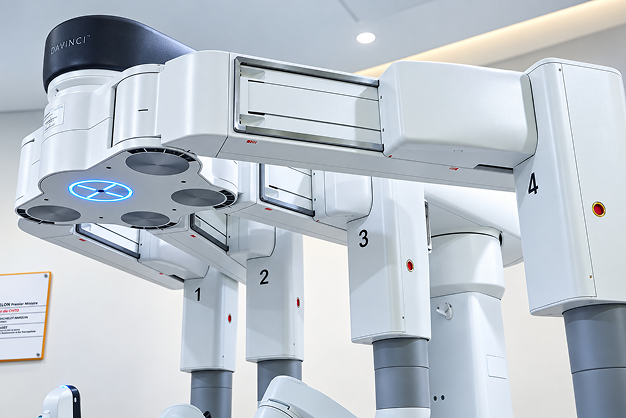
One of the remarkable systems created by integrating the latest technologies in modern medicine is the surgical robot. Among these, the Da Vinci Xi is one of the most advanced operating systems that has brought revolutionary changes to the field of Robotic Surgery in general surgery worldwide.
One of the major concerns among many people is whether robots make their own decisions and perform surgeries independently. However, this is a completely incorrect perception. Medical robots do not make decisions or perform surgeries on their own.
It is a Master-Slave System. This means that the surgery is performed entirely by an experienced surgeon. The robot is simply a device that accurately carries out the instructions given by the surgeon. This makes Robotic Surgery a surgeon-controlled procedure rather than an autonomous operation.
Compared to laparoscopic (keyhole) surgery, Robotic Surgery vs laparoscopic surgery offers several advantages in the field of general surgery. These Robotic Surgery benefits can be particularly valuable in complex procedures requiring enhanced precision and control.
These advantages have contributed to the growing adoption of Robotic General Surgery and Robotic Surgery in India.
Today, Da Vinci Xi Robotic Surgery is widely used in general surgery for the following conditions:
(Complex hernias of the abdominal wall)
In complex inguinal, ventral, or recurrent hernias, robotic hernia surgery provides excellent precision for suturing the abdominal wall muscles together (Abdominal Wall Reconstruction) and placing mesh.
(Stomach, colon and rectal cancers)
In rectal cancer surgeries, particularly those involving tumors close to the anus, the tumour can be removed while precisely preserving the nerves responsible for urinary function and sexual function. In stomach cancer surgeries, it helps in the complete removal of lymph nodes. Such procedures are an important part of robotic gastrointestinal surgery and robotic cancer surgery.
(Liver, gallbladder and pancreas)
In procedures such as Whipple's Procedure for pancreatic cancer, removal of liver tumours, and complex gallbladder removal, Robotic Surgery helps in precisely cutting and suturing delicate blood vessels and ducts without causing damage.
(Surgery for obesity)
In patients with obesity, laparoscopic surgery can become challenging because of the thickness of abdominal fat. Robotic arms can be used to perform procedures such as gastric bypass and sleeve gastrectomy safely.
(Oesophagus and diaphragm)
Procedures such as Fundoplication for acid reflux disease, Achalasia Cardia surgery to treat obstruction of the oesophagus, and Hiatal Hernia surgery can be performed without large incisions in the chest or abdomen.
Like any new advanced technology, Robotic Surgery may initially cost slightly more than conventional procedures. However, considering the safety provided to the patient and the faster recovery, it can be considered cost-effective. Moreover, health insurance coverage is now available for most robotic surgeries.
The Da Vinci Xi has been designed with future tele-surgery applications in mind as well. This means that patients in remote locations could potentially be operated on by expert surgeons working from centres equipped with similar robotic systems.