
Caritas Cancer Institute
CAR T-Cell Therapy – The Living Drug in Cancer Treatment
May 2026

Author: Dr. Jojo V. Joseph, Senior Consultant – Surgical Oncology
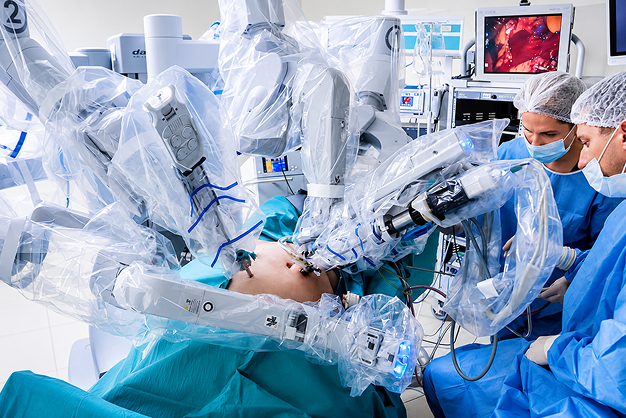
For the past several decades, the field of cancer treatment has been changing rapidly. Advances in diagnosis, newer medicines, and more precise radiation therapy have brought significant improvements to the lives of cancer patients. However, one of the most remarkable developments has been the technological revolution in the field of surgery. Today, Robotic Surgery, particularly advanced Robotic-Assisted Surgery using systems such as the Da Vinci Xi Surgical System, is transforming the way cancer surgery is performed across the world.
At Caritas Cancer Institute, one of Kerala’s leading comprehensive cancer care centres, this technological transformation is becoming an important part of modern cancer treatment. With the aim of making world-class cancer surgery available closer to home, Caritas has incorporated Advanced Robotic Surgery into its cancer treatment services. The Da Vinci Xi Robotic Surgery platform combines advanced visualization and precision instrumentation with the expertise of trained surgeons to support selected complex procedures.
There was a time when most Cancer Surgery procedures were performed through large incisions. Large openings were required to provide adequate access to the affected organ and remove the disease completely. As a result, patients often experienced greater pain and blood loss and had to spend more days in the hospital.
The introduction of laparoscopic surgery made it possible to perform procedures through smaller incisions. This helped patients recover faster and reduced hospital stays. However, laparoscopic surgery had certain technical limitations, particularly when operating in confined areas of the body such as the pelvis, chest, and regions around the liver and pancreas.
Robotic-Assisted Surgery emerged to overcome some of these limitations. It combines the capabilities of the human surgeon with the precision and technological assistance of a robotic surgical platform. This has made Minimally Invasive Robotic Surgery one of the significant advances in modern surgical care.
The Da Vinci Xi Surgical System, for example, is designed to provide advanced 3DHD visualization and wristed instruments, allowing surgeons to perform complex minimally invasive procedures with enhanced visualization, control and instrument articulation.
When people hear the term Robotic Surgery, many imagine a machine independently performing an operation. That is not the reality.
A surgical robot does not have its own intelligence or decision-making ability. Every movement is controlled by the surgeon. In Robotic-Assisted Surgery, the surgeon sits at a specialized console and views the surgical area in a highly magnified three-dimensional format. At the patient’s side, robotic instruments perform movements controlled by the surgeon.
With the Da Vinci Xi Surgical System, the surgeon remains in control of the camera and instruments from the console. The system is designed to translate the surgeon’s hand movements into precise movements of the instruments inside the body.
The robotic system can also filter out small natural tremors of the human hand. Its wristed instruments can move through a range of angles beyond the natural movement of the human wrist, enabling delicate procedures in confined anatomical spaces.
This combination of surgeon expertise, robotic precision, 3D visualization and minimally invasive techniques makes robotic-assisted surgery particularly valuable for selected complex procedures.
The objective of cancer surgery is not merely to remove a tumour. The goal is to remove the disease completely while preserving normal body functions as much as possible.
This is where Robotic Cancer Surgery and Robotic Surgery for Cancer can offer important technological advantages in appropriately selected patients. For example, during colorectal cancer surgery, it may be important to preserve nerves associated with bowel and bladder control. Similarly, during prostate cancer surgery, preserving the nerves associated with urinary control and sexual function can be important.
In such situations, advanced robotic surgical technology can provide valuable assistance to the surgeon. The three-dimensional visualization and high magnification available with robotic surgery help the surgeon distinguish diseased tissue from healthy structures more clearly. This can assist in precise dissection while helping to preserve important anatomical structures.
The Da Vinci Xi Robotic Surgery system provides highly magnified 3DHD visualization and advanced wristed instrumentation. These capabilities are designed to support surgeons when performing minimally invasive procedures in anatomically challenging areas.
One of the greatest potential advantages of Minimally Invasive Robotic Surgery is the benefit it can offer patients.
Because surgery can be performed through small incisions rather than large openings, postoperative pain may be reduced. Blood loss is also generally lower in many minimally invasive procedures, which can reduce the likelihood of requiring a blood transfusion.
Smaller incisions may also reduce the risk of wound-related infection. Patients can often begin walking and eating sooner and, depending on the procedure and individual recovery, may return home within a shorter period.
These potential Robotic Surgery Benefits can include reduced postoperative discomfort, smaller surgical incisions, potentially lower blood loss, shorter hospital stays and a faster return to normal activities in appropriately selected cases.
A shorter hospital stay can reduce the emotional stress experienced by patients and the financial burden on their families. For people who are working, faster recovery can also help them return to their routine sooner.
This is particularly relevant for cancer patients because additional treatments such as chemotherapy or radiation therapy may sometimes be required after surgery. A faster postoperative recovery can help enable subsequent treatment to begin according to the treating team’s plan.
However, the benefits of robotic surgery can vary depending on the type of procedure, the patient’s condition, the disease characteristics and the surgeon’s experience. Robotic surgery is not necessarily appropriate for every patient, and the most suitable surgical approach should always be determined by the treating surgical team.
Today, Robotic Surgery for Cancer is used in the treatment of several types of cancer, depending on the individual patient and the nature of the disease.
Robotic-assisted surgery is widely used in selected cancers of the digestive system, including:
In particular, Robotic Surgery for Colorectal Cancer can be useful in selected patients where precise dissection is required in anatomically confined areas such as the pelvis. The enhanced visualization and articulation of robotic instruments can assist surgeons during complex colorectal procedures.
Robotic technology has also brought significant advances to Robotic Surgery for Lung Cancer. It can help surgeons work with greater precision in confined areas within the chest and perform selected minimally invasive thoracic procedures.
Robotic systems can also assist in selected complex procedures involving the liver, pancreas and bile ducts, depending on the disease and surgical assessment.
Around the world, robotic surgery is also used in selected cases of:
Robotic Surgery for Prostate Cancer has become an important application of robotic-assisted technology in urological oncology. The ability to visualize and dissect delicate anatomical structures can assist surgeons in procedures where preservation of surrounding structures is important.
Similarly, Robotic Surgery for Urological Cancer can be used in selected cases involving the prostate, kidney and other parts of the urinary system.
In women’s cancer care, Robotic Surgery for Gynaecological Cancer may be considered for selected patients with conditions such as uterine and cervical cancers, depending on the stage and location of the disease.
The suitability of robotic cancer surgery depends on several factors, including the type and stage of cancer, the patient’s overall health, the anatomy involved and the surgeon’s assessment.
For more than two decades, Caritas Cancer Institute has been providing comprehensive cancer care services in Kerala. The institute offers an integrated cancer care system that brings together multiple areas of cancer treatment, including surgical oncology, medical oncology, chemotherapy, haematology and haematologic oncology, paediatric oncology, genetic laboratory services, radiation therapy, nuclear medicine, interventional radiology and palliative care.
The introduction of Advanced Robotic Surgery has further strengthened the surgical capabilities at Caritas. Procedures that were previously considered highly complex can, in selected cases, now be performed with the assistance of modern robotic technology.
The availability of Robotic Surgery in Kerala provides patients with greater access to advanced minimally invasive surgical techniques. For appropriately selected patients, Robotic Cancer Surgery in Kerala can form an important part of a comprehensive cancer treatment plan.
At Caritas Cancer Institute, the integration of robotic technology with surgical oncology expertise enables a multidisciplinary approach to cancer care. Patients can be evaluated by the appropriate specialists to determine whether Robotic Oncology Surgery, conventional open surgery, laparoscopic surgery or another treatment approach is most suitable.
For patients, one of the major advantages is access to advanced surgical technology and comprehensive cancer care closer to home. The aim is to provide modern Minimally Invasive Cancer Surgery wherever clinically appropriate, while maintaining the principles of safe and effective cancer treatment.
Robotic surgery has strengthened not only the surgical department but also the overall cancer care system at Caritas Cancer Institute. As postoperative recovery improves in appropriate cases, coordination with other oncology specialties can also become more effective.
No matter how advanced robotic surgery becomes, the human being remains at its centre.
A robot cannot speak to a patient, understand a patient’s fear or provide emotional reassurance. These responsibilities belong to doctors, nurses and other healthcare professionals.
At Caritas, the patient remains more important than the technology. Every patient is evaluated individually, and the most appropriate treatment approach is selected based on the patient’s specific needs.
Robotic Surgery is not necessary for every patient. However, for patients who are appropriate candidates, the aim is to make the full potential of this advanced surgical technology available to them.
This patient-centred approach is essential in modern Robotic Oncology Surgery. Technology should support clinical expertise rather than replace it. The decision to choose robotic-assisted surgery should always be based on careful evaluation by an appropriately trained surgical team.
We are entering an era where technologies such as artificial intelligence, image-guided surgery and augmented reality are increasingly being integrated with robotic surgery. These developments have the potential to make future cancer surgery more precise and technologically advanced.
The future of Robotic Cancer Surgery is likely to involve continued advances in surgical visualization, instrumentation, image guidance and digital technologies. However, every technological development must ultimately serve one purpose: providing patients with safe, effective and compassionate care.
Caritas Cancer Institute is committed to being part of this journey. Bringing together modern technology, scientific medicine and compassion to provide patients with the best possible care remains at the heart of our mission.
Robotic Surgery is not merely the story of a machine.
It is the story of an effort to reduce the burden of surgery for patients. It is the story of supporting faster recovery and helping patients return to a better quality of life. It represents a new chapter of hope in the fight against cancer.
At Caritas Cancer Institute, our journey continues towards turning that hope into reality—by bringing together advanced Da Vinci Xi Robotic Surgery technology, the Da Vinci Xi Surgical System, skilled surgical expertise, comprehensive cancer care and the human touch that every patient deserves.

Caritas Cancer Institute
May 2026
Caritas Cancer Institute
May 2026